DECI Turns to Fall Fest After a Summer Frenzy of Activity
Downtown Eau Claire Inc looks back on summer before getting into their hallmark event on September 12, 2026.
By: Willow Pawlisch
Erin Klaus, executive director of Downtown Eau Claire Incorporated, has been navigating winds of change in recent times.
“We have been around for about 24 years,” Klaus said. “And in the last two years we officially left the umbrella of the city of Eau Claire.”
Formerly functioning as a quasi-government, nonprofit organization, now Downtown Eau Claire Incorporated (DECI) is an officially independent 501c6 nonprofit functioning similarly to a chamber of commerce. However instead of serving the greater business community, DECI focuses solely on downtown.
The City of Eau Claire organizes its downtown into four business improvement districts (BIDs). Each holds their own board and funding to support that section of downtown. They manage beautification, events, and upkeep of the general area. DECI relies on contracts with the BIDs for the majority of their work throughout the year.
The South Barstow BID tree lights, the Water Street BID’s Eaux Claires Faire, the West Grant Avenue BID’s flower baskets, and the North Barstow BID’s farmer’s market at Phoenix Park are just some of the things the BIDs manage in their operations.
“Our events are the big shiny thing,” Klaus said. “Because most of our time is spent supporting the business improvement district's beautification and work efforts. Things that I would say I’m most proud of at DECI is the work we do there and its handling and running grant beautification programs to get murals on buildings or facade improvements. It's things like that that build community long-term. “
On top of the regular management of downtown, DECI also has been shouldering the information roll-out of downtown parking initiatives—a hot-button issue they’ve been involved with since 2023.
“We knew what we were getting into when we got into it,” Klaus said. “One of the things for us is we knew we could tell the story the best and get information into the hands of the people who needed it.”
That downtown paid parking proposal in 2023 was staved off by the BIDs, DECI, and other city staff, who collectively called to wait for new parking study to replace an outdated 2015 analysis.
More recently, paid parking was slated for implementation on June 1, 2026, yet was delayed again due to the payment kiosks' late delivery. Kiosks lobbied for by DECI to support citizens paying for parking with cash as an alternative to downloading the app.
A partnership between DECI, Visit Eau Claire, and Justin Vernon’s Eaux Claires Festival bookended the summer with the Water Street Faire.
“The Water Street Business Improvement District in the past couple years has been really wanting to ignite the environment on Water Street,” Klaus said.
Logistics staunch the ability to hold events on Water Street. As a double-wide thoroughfare, security and safety risks sat at the top of city officials' minds when the event was proposed.
The benefit of Water Street as an event venue is the amount of space compared to squeezing Fall Fest into the nooks and crannies of Barstow Street. The Eau Claire Fall Festival has grown over the 37 years of existence from featuring just local vendors to what Klaus calls “engagement zones”.
Some engagement zones this year will feature music, sports, carnival games for families, and entertainment spots sprinkled across the expanded footprint of the event. Due to record 14,000 people attendance last year the event will now take up Barstow street all the way down to Wisconsin Street on the other side of the bridge.
Klaus says this will allow better breathing room for people to explore vendors, food trucks, and all the other things people might’ve overlooked last year due to overcrowding.
“I think the problem is access to geofencing data is expensive, and we’re working to become Main Street Accredited with the Wisconsin Economic Development Corporation and some of those resources come along with membership,” Klaus said. “In the past, we were touting that we had five or six thousand people, but then we got this geofencing data. And [14,000] is just adults with cellphones.”
In the future, DECI aims to push themselves to create identity within downtown Eau Claire between BID contracts, events, and other jobs they take on throughout the year.
Along with new leadership in the city and university, Klaus is optimistic that the relatively recent change in DECI’s status will continue to foster new ideas in the Chippewa Valley.
Pawlisch is available to be reached at wppawlisch@gmail.com.
Looking Back at River Prairie: 20 Years Later
Altoona City Administrator Mike Golat talks about the development of River Prairie
By: Willow Pawlisch
The growth of the Chippewa Valley over the past 20 years witnessed changes to many parts of the area. Namely the ambitious River Prairie Development in Altoona, Wisconsin, isn’t just a commercial or residential center, but works as a place for community. It serves as the new welcome mat for Altoona.
River Prairie began a growth opportunity for the City of Altoona when the new Highway 53 bypass was created. A wealth of empty land right next to a major road interchange fell into Altoona’s lap. A Tax Increment Financing District was formed in 2001 and planning documents were prepared before Mike Golat came to the city in 2006.
“In my interview, I asked, ‘How will the success of the new city administrator be measured,’” Golat said. “They said, ‘Largely by how River Prairie goes,’ so that was a very large priority in 2006.”
As City Administrator for a little over two decades, Golat has been around for most major milestones of the River Prairie Development. Sized around 125 acres, the area presented itself as a challenge to make returns to the Tax Increment Fund at first.
“You think you're doing the right thing,” Galot said. “You think you're hitting the right spots and putting the right elements in, but until it starts operating and you see whether people show up and whether they love it or not you don’t know.”
A Tax Increment District (TID) is a classification of land that a city wants to develop. The properties are evaluated to be taxed at a base value, and as people build or develop the land, any added property value taxes get sent to a separate fund instead of being distributed with the base tax rate. Over many years, that tax increment fund is used to create infrastructure like roads, parks, sewers, or in this case a public park.
“Before I got here the council had contemplated it as a mixed-use development,” Golat said. “Which meant it would have a mix of residential convenience use, institutional government, significant park space, so when I got here, we had a good blueprint generally for what elements they wanted in the park, and I just needed to work with council to figure out what that meant specifically.”
In 2011, the district was almost declared distressed due to a lack of development, but over the following years Kwik Trip, Woodmans, and Oak Leaf Medical started building in the area, kickstarting growth.
Galot credits West Central Regional Planning with helping create frameworks to integrate the commercial and public spaces imagined for River Prairie. He talked about taking advantage of natural resources and creating river access for park-goers. Another wish was an outdoor amphitheater, which now boasts an outdoor concert series on Monday and Wednesday nights during the summer.
“For me as a city administrator, it was an incredible opportunity,” Galot said. “To do something you could actually see and really make a difference in the community, which was really exciting and fun, and thankfully people have embraced it because you never know as you’re planning something.”
In 2025, the city decided to extend the TID for one additional year, and the resulting funds poured over 6 million dollars into an affordable housing fund. The city is currently looking into several programs to use other funds.
The River Prairie development is now known for its restaurants, local businesses, hotels, and various other large businesses that have chosen to build in the area. Though the public park is a bigger draw with a seemingly endless calendar of events in the summer and fall months. A park created with funds from the businesses that chose to invest in the space.
“I know a lot of city administrators that work their whole career and never have the opportunity to do something that's this cool,” Golat said. “And the only way that can happen is with an amazing city council that formed the vision, bought into it, and held to it to make it come to fruition.”
Learn more at visiteauclaire.com/river-prairie/
Pawlisch can be contacted at wppawlisch@gmail.com.
Second Season with Massive Video Board brings Opportunities for Innovation for Eau Claire Express
The board offers the chance to highlight players, fans, and sponsors
By Willow Pawlisch
Heading into the 2026 summer season, the Eau Claire Express media team is flexing its muscles working the WNB Financial video board. Though last year the board was installed on the Wednesday right before opening week, this year they’ve had time to experiment in the off-season and are enjoying new ways to utilize the board.
Ben Peterson, director of media relations for the Express said the Northwoods League has high standards, and this board is another step towards hitting that standard for fans, players, and sponsors alike.
“Its a brand new revenue stream,” Peterson said. “We’re sold out on billboards on the outfield wall—have been for years. That's always been a popular thing, and so when businesses say they’d love to get some brand recognition, to get in front of Express fans, it essentially gives us unlimited ad space.”
Last year the board was mostly used in conjunction with the written script through announcer Paul Schommer. Eau Claire Express games have a production schedule filled not just with innings. They feature theme nights, crowd games, promotions, and endless other tidbits that can now be tied in with video accompaniments.
“Something as simple as we would read the 50/50 ticket winner in the 7th inning,” Peterson said. “In the past we would read that multiple times because there was no visual queue showing you what number. Now the intern whose managing it texts the PA in the press box, we relay it to whoever is running the graphic board, and we’ll live update that graphic right then and there. Functionally it makes a huge difference”
Riley Tassone, photo and graphic design intern this summer, has taken on a lot of responsibility with the day-to-day operations of the video board. He said the board gives them the ability to make games more engaging.
“I don't think there's an inning that goes by when we don’t have a promotional game or promotional video,” Tassone said. “We have almost one game an inning and when there isn’t a game we have our ‘Guess The Attendance’ or it's a waste management trivia game or something like that.”
With a portion of the Eau Claire Express team being seasonal interns or part-time staff, Ben Peterson emphasized that the video board helps support the interest of students in the community. He helps out as a club counselor for the Eau Claire Memorial High School Daktronics Club: Daktronics, the same company that created the WNB Financial Board for the Express.
“This is a developmental league,” Peterson said. “It's a developmental business, so all the way down to that high school camera operator, to the interns making the graphics, to the players on the field it's everybody trying to learn, trying to get better, and try to move on to that next level.”
For players on the field, Tassone said the board brings a new way for them to experience the game from the dugout. A big part of Tassone’s job is to create the graphics you see of players on the board during starting line-ups and at various points throughout the game. This helps fans know who is on the field, but it also helps any recruiters in the stands learn about players as well.
Since 2005, the Eau Claire Express has watched dozens of its alumni continue into professional baseball. 11 of those players made it to the major leagues, and a point of pride for Peterson is also the internship alumni who have gone on to work for major sporting teams. He mentioned Allie Schendel, an intern from last year, who is now working for the Miami Heat.
Peterson said the next step in developing the usage of the board is their camera team. He looks forward to working with part-time staff and interns to find new ways to use the board.
To catch an Express game this summer check out Home - Eau Claire Express.
Willow Pawlisch can be reached at wppawlisch@gmail.com.
--------------------------------------------------------------------------------------------------------------------------------------------
Eau Claire City Council President Jeremy Gragert Talks Transit and Parking
Gragert touches on downtown parking plans, encouraging bus ridership, and new Chippewa Valley Bike Map
By: Willow Pawlisch
Jeremy Gragert, current Eau Claire City Council President, has been in office for just under two months. Between 2018 and 2024, he represented District 3 for two terms on City Council, but he’s been involved in Eau Claire’s local government for much longer than that.
Before joining the council he helped to create the Chippewa Valley Bike Map (2021), the City of Eau Claire Sustainability Advisory Committee (2014), and collaborated with several city staff members to promote community gardens and bike and walking trails throughout the community.
Frustration with the city transit system is part of the reason he got involved. Since he doesn’t own a car, Gragert has gotten very familiar with public transit, walking, and biking paths around the Chippewa Valley. He hopes to support this effort even more over his 3-year term with the release of a 2026 Chippewa Valley Bike Map this summer.
“There is a churning of things and needs downtown from various perspectives,” Gragert said. “I tend to focus more on how we can make it easier to walk and bike and take transit downtown, as opposed to relying as much on parking, but I recognize the need to find parking as well.”
Eau Claire City Council approved a new paid parking plan for downtown Eau Claire to take effect on June 1st. It was then delayed to August 1st because the kiosks used to implement the system are taking longer than anticipated to be installed.
Gragert said the decision was made before he was council president, but he understands the motivation to implement paid parking.
“The point of putting a price on it is to make that more available,” Gragert said. “Because people decide ‘I’m only going to use this parking spot as long as I need to’ as opposed to ‘I’ll leave my car here all day’.”
Gragert also talked about City Council’s focus on long-term planning. Eau Claire’s City government is modelled on an elected council that hires a city manager, who then hires the rest of city staff. Gragert said his role on the council beyond chairing meetings is mostly about facilitation between the council and city manager.
“I have a full time job, so I think the position is somewhat of what you make of it and how much time you have as well,” Gragert said. “Some of it is sharing responsibility with the rest of the city council, so there’s a certain amount of cooperation from the council to make sure that we’re representing the public in the best possible way.”
Gragert explained over the next five to ten years the council will be looking at a variety of issues from replacing or creating fire stations, the space between the library and city hall, waste water treatment, public transit, and parking ramp replacement.
Gragert attended university at UW-Eau Claire, and on the cross country team and as a cyclist he spent a lot of time finding the non-automobile ways of getting around. He said that the experience led him away from Eau Claire’s hidden gem: the bus system.
“We need to promote and provide good public information about our bus system,” Gragert said. “Especially if we’re going to have paid parking coming downtown. Especially if we have renewable energy and carbon neutrality goals.”
Gragert has focused on public transit accessibility goals with reduced bus-fare programs implemented over the years, and a recently accomplished free bus ridership for K-12 students, a program Gragert pushed for his first time on the council. It is a path he wants to continue.
“I’m hopeful we can improve the maps, apps, and bus routes to make it easier for people to use the buses,” he said.
Another issue Gragert spoke about was the upcoming Comprehensive Plan. Starting in Summer 2026, the city will begin public engagement opportunities to talk about the long-term goals of growth in Eau Claire to include in the newest Comprehensive Plan.
Gragert hopes to keep expanding the conversation to talk about not just paid parking, but also non-automobile transportation opportunities.
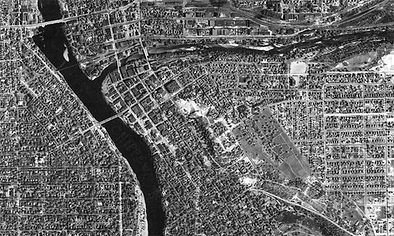
[caption: 1939 aerial view of Eau Claire, centered on the downtown. (Photo via Chippewa Valley Museum) ]
Gragert said, “If you look at an aerial photograph of the City of Eau Claire in the 1930’s downtown area, there was maybe one parking lot where the farmers would go and sell produce. That was the only parking lot in the 1930’s because not many people had cars and public transit was decent and a lot of people lived in high density neighborhoods close to downtown and could walk.
A lot of that was torn down over this obsession with trying to accommodate the automobile, and some of the buildings were old too so they decided to just take one down, take that one down too, but eventually we ripped down half of our downtown buildings and even whole neighborhoods like around Mayo. They ripped down 15 square-blocks of housing. The county building has ripped down blocks of housing—even the senior center. And we’ve been talking about affordable housing. How much of it did we tear down for parking lots?”
To listen to the full conversation go to Eau Claire Hometown Media’s Spotify.
Willow Pawlisch can be reached at wppawlisch@gmail.com.
The next City Council meeting can be found at Meetings | City of Eau Claire, Wisconsin.